Tiny Powerhouses: Why Mini Workstations Matter for Video Editors
Mini workstations have matured into serious tools for video editors who need power in a small footprint. They suit freelancers, mobile editors, and small studios that prioritize speed, space, and noise control. Performance now hinges on multi‑core CPUs, GPU acceleration, and low‑latency NVMe storage combined with efficient thermal design.
This article compares mini workstations objectively and focuses on measurable throughput, sustained render performance, and practical bottlenecks. It covers six structured sections: Hero, Quick Summary and Shortlist, Technical Breakdown, Real‑World Use Cases, Pros and Cons, and Final Verdict. Buyers should expect tradeoffs in expandability and potential thermal throttling. The goal is clear guidance for configuring a compact system that delivers MASSIVE throughput for real editing workflows. Recommendations remain vendor-neutral and practical.
📋 Free: Mini PC Buying CheatsheetThe 7-question framework we use to pick the right mini PC. Instant download.
A true mini‑workstation “hero” balances efficiency and sustained throughput. Key differentiators are CPU micro‑architecture efficiency per watt (high IPC cores with turbo headroom), discrete GPU decode/encode acceleration, direct NVMe CPU lanes, robust power delivery, and a cooling design that preserves sustained clocks under long exports. Real-world wins come from systems that prioritize direct PCIe lanes to NVMe and a roomy thermal envelope over flashy peak benchmarks.
Editor's Choice
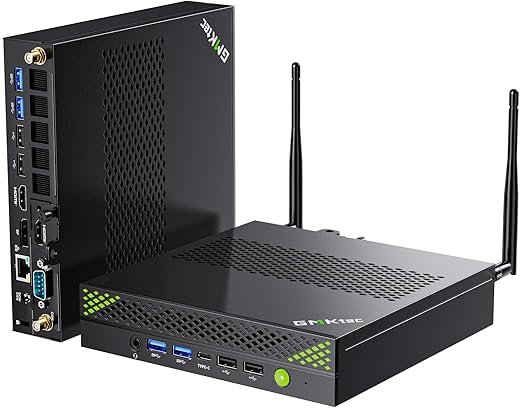
GMKtec K10 i9-13900HK Mini Workstation PC
High-end 14C/20T performance, 32GB DDR5
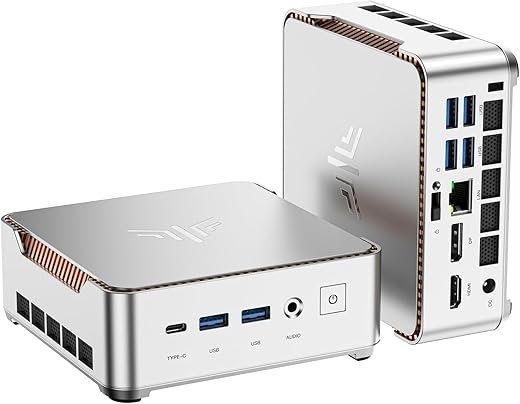
hero: A compact mini workstation packing mobile-class Core i9 performance for demanding workflows. quick summary: It delivers near-desktop multi-threaded performance and extensive I/O in a small chassis for pro users who need compute density. technical breakdown: Intel Core i9-13900HK (14C/20T, up to 5.4GHz), 32GB DDR5, 1TB PCIe NVMe, triple/quad display support including DP1.4 and HDMI2.0, 2.5G LAN, WiFi6, COM port for industrial integration, multiple USB 3.2 ports and M.2 expansion (up to 3 slots). real-world use cases: Ideal for video editing, software development, virtualization labs, industrial control systems, and multi-monitor trading or design stations. pros/cons: Pros — top-tier CPU performance, DDR5 memory, rich port selection (including COM), expandable storage; Cons — higher power/thermal demands, pricier than entry mini PCs. final verdict: It is the best choice when compact form factor cannot compromise on raw CPU throughput; objectively outperforms the Ryzen mini for CPU-bound tasks but consumes more power and costs more.
Prefer systems with ≥2 NVMe slots where at least one is on direct CPU lanes.
Discrete GPU for multi‑stream 4K/8K playback (hardware decode + CUDA/ROCm).
Cooling that sustains full power for 15–60 minute renders.
Thunderbolt 4 as a secondary option for external NVMe arrays.Tip: for immediate performance, configure an NVMe for OS/apps, a second NVMe (or RAID0) for active media.
Technical breakdown (what to look for)
NVMe x4 vs x8: x4 per drive suffices for most 4K work; x8 or NVMe RAID is beneficial for sustained 8K workflows.
Direct CPU lanes vs chipset: direct lanes reduce latency and increase sustained I/O under heavy CPU/GPU load.
Power delivery: stable 8‑12 phase VRMs help maintain turbo clocks during long exports.How-to: prioritize direct-lane NVMe for scratch, use the chipset lanes for archival SSDs.
Real‑world throughput & use cases
Expect ~2.5–4.5 GB/s sustained from a single modern NVMe for multi‑4K timelines; NVMe RAID or x8 links push 6–10 GB/s for native 8K timelines. For live multicam 4K editing, a compact system with a mid‑range discrete GPU and dual NVMe drives will eliminate most playback stalls.
Pros / Cons (at a glance)
Pros: excellent price/perf density, low footprint, fast scratch disks.
Cons: limited expansion, potential thermal throttling, higher cost per bay.
Final verdict (buying nudge)
Buyers should prioritize NVMe lane topology and cooling over peak clock specs; next, the Quick Summary and Shortlist will turn these priorities into concrete model picks and configuration checklists.
2
Quick Summary and Shortlist: Pick the Right Mini Workstation
Buyer profiles and immediate priorities
Mobile editor — They value quiet operation, Thunderbolt expansion, and balanced NVMe performance for multi‑4K timelines. Prioritize single‑drive sustained sequential throughput (~2–3 GB/s), good cooling, and TB4 for external RAID.
Solo freelance colorist — They need low latency and high random I/O for heavy project databases and cache. Prioritize high IOPS and low 4K random‑read/write latency, plus a GPU with solid color pipeline support.
Small studio compositor — They depend on GPU compute and VRAM. Prioritize powerful discrete GPU, higher sequential bandwidth (3–8 GB/s) and PCIe lane availability for GPU + NVMe.
On‑set dailies operator — They require sustained throughput and reliability for long ingest sessions. Prioritize multi‑slot NVMe (or hardware RAID), sustained transfer measured over 15–30 minutes, and robust thermals.
Best for Creators
HP Workstation with Quadro K1200 and SSD
Certified ISV workstation for creative applications
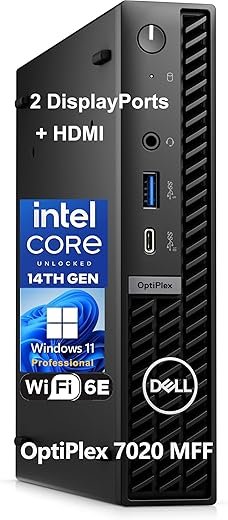
hero: A renewed workstation configured for professional content creation with certified Quadro GPU. quick summary: It balances ISV compatibility, large storage, and workstation-class GPU drivers for stable creative workloads. technical breakdown: Intel 8th‑Gen Hexa‑Core i5, NVIDIA Quadro K1200 4GB (ISV‑certified), 32GB DDR4, 1TB SSD boot + 4TB HDD data store, multiple DisplayPort outputs plus legacy VGA/serial, Windows 11 Pro (renewed). real-world use cases: Engineered for CAD, 3D modelling, video/photo editing, and legacy software that requires certified GPU drivers. pros/cons: Pros — ISV certification, large combined storage, plenty of RAM; Cons — older CPU/GPU generation limits ray‑tracing and modern GPU acceleration, refurbished condition may vary. final verdict: It is a practical, cost-effective workstation for established creative workflows and legacy software; compared to new mini workstations, it trades cutting-edge single‑thread and GPU performance for certified stability and greater storage capacity.
Quiet mobile: laptop/mini with Thunderbolt 4 and tuned acoustics — for on‑the‑road editors.
Maximum throughput: dual x4/x8 NVMe RAID, high‑end GPU, beefy cooling — for 8K timelines and continuous ingest.
How to read benchmarks when choosing
GB/s sequential: measures bulk throughput — key for multi‑stream playback and large file copies.
IOPS & 4K random: indicates responsiveness for caches, databases, and metadata-heavy projects.
Sustained transfer (15–30 min): reveals thermal and throttle behavior under real workloads — the most practical metric for dailies and long exports.
Codec playback tests: run real codec timelines (ProRes, H.264/265, RAW) to confirm playback headroom; synthetic numbers can be misleading.
Readers can use these priorities to map needs to hardware; the next section drills into micro‑architectures, storage topologies, and thermal tradeoffs that make those metrics real.
3
Technical Breakdown: Micro‑Architectures, Storage Topologies, and Thermal Tradeoffs
CPU micro‑architectures: cores, IPC, and power envelopes
In compact workstations the CPU choice is a tradeoff between single‑threaded responsiveness (editing, scrubbing, UI) and multithreaded export throughput. Higher IPC architectures (e.g., recent Intel Core P‑series or AMD Zen 4C/Zen 4 desktop cores) give better snappiness per core; more cores win long renders. In small chassis power envelopes matter: a 65 W 8‑core chip often outperforms a 35 W 8‑core variant in sustained exports because turbo windows and PL2 are larger. Measure both single‑core Cinebench or 1T scores and multi‑core sustained watts when comparing parts.
GPU roles and limits
GPUs serve three roles: hardware decode/encode (NVDEC/Media Engine), VRAM for framebuffers/composites, and compute (CUDA/Metal/OpenCL). For multi‑layer timelines, VRAM capacity is often the earliest bottleneck — 8–12 GB is minimum for 4K heavy compositing; 16+ GB is safer for 6–8K. Hardware codecs offload CPU but rely on driver maturity; test real ProRes/HEVC timelines to validate claimed throughput.
High-Speed Storage
Samsung 990 EVO Plus 1TB PCIe Gen4 SSD
Up to 7,150 MB/s sequential read
hero: High-performance NVMe SSD tuned for fast transfers and large-file workflows. quick summary: It accelerates project load times, large transfers, and general system responsiveness with Gen4-class speeds and thermal controls. technical breakdown: PCIe Gen4 x4 (Gen5 x2 compatible), sequential reads up to 7,150 MB/s and writes up to ~6,300 MB/s (Intelligent TurboWrite), Magician software support, nickel-coated controller for efficiency and thermal management. real-world use cases: Best for content creators moving large video files, gaming rigs needing fast asset streaming, and workstations requiring quick scratch/storage performance. pros/cons: Pros — excellent sequential throughput, intelligent write caching, strong software ecosystem; Cons — not the absolute top PCIe 4.0/5.0 performer (see 990 PRO), performance varies by platform and firmware. final verdict: It is an excellent high-speed SSD for demanding workflows that need sustained large-file throughput; compared to the 990 PRO, it offers great value but slightly lower peak sustained performance and efficiency.
NVMe is low‑latency, high‑IOPS over PCIe lanes. Controllers with onboard DRAM keep the FTL mapping fast; DRAMless drives can use Host Memory Buffer (HMB), but HMB performance depends on platform drivers and available RAM. NAND type matters: TLC (3‑bit) delivers far better sustained write endurance and consistent throughput than QLC (4‑bit), which will fall off sharply during long ingest/export phases. Look for sustained write ratings and 15–30 minute transfer tests, not just peak GB/s.
PCIe lane allocation and small‑form‑factor topologies
Mini systems have limited CPU lanes; common topologies:
Single NVMe on direct CPU lanes — lowest latency, best bandwidth per drive.
Dual NVMe on direct lanes (x4+x4) or CPU+chipset mix — best for parallel throughput.
NVMe behind PCIe switch chips — enables more drives but adds latency and may bottleneck at the switch upstream link.
External Thunderbolt/USB4 arrays — convenient (40 Gbps TB4 ≈ 3.5–4.5 GB/s real world) but introduce protocol overhead and host controller dependence.
When comparing claims, check whether drives are on CPU lanes, chipset lanes, or behind a switch; that determines real-world headroom.
Thermal and power interplay
M.2 modules throttle when controller/NAND temps rise; small chassis exacerbate this. Cooling options: heatsinks, heat pipes, and vapor chambers that tie SSD, CPU, and GPU to common airflow paths. However, shared heat pipes can couple temperatures — heavy NVMe use can nudge CPU/GPU turbos down if thermal design power (TDP) and PSU headroom are tight. Practical tips:
Prefer drives with a DRAM cache and larger SLC/TLC caches for ingest.
Insist on sustained transfer graphs from vendors or third‑party reviews.
Allocate CPU headroom (choose 65–95 W TDP parts in minis) and ensure the PSU/topology can supply simultaneous peak CPU+GPU+NVMe draw.
These primitives (IPC vs cores, VRAM vs codec offload, lane topology, NAND endurance, and thermal coupling) provide the vocabulary to map benchmark numbers to real throughput behavior and spot the bottleneck most likely to surface in a given workflow.
4
Real‑World Use Cases: Workflows, Benchmarks, and Expected Throughput
Multicam 4K editing with color grading
Editors working 4K multicam (8–12 angles) with color nodes should expect 4–10 realtime ProRes/HEVC lanes depending on codec. A single PCIe Gen4 x4 NVMe can sustain 2–4 ProRes HQ streams; RAID‑0 across two drives or a PCIe x8 host is needed for higher lane counts. Cache sizing: allocate 1–2× timeline length on a fast NVMe for render/cache files to avoid stuttering during heavy grading.
Native 6K/8K raw handling (proxy vs native)
Native 6K/8K RAW is possible but storage hungry. Native playback of one 8K RAW stream can demand multiple GB/s under some codecs; practical mini strategies favor proxy workflows (1–2GB/s proxy storage) and only switch to native for final color/grade on RAID/NVMe arrays or TB4 enclosures for short passes. Long ingest/export requires drives with large sustained write windows (avoid QLC for heavy RAW).
Best Organizer
6-Slot M.2 SSD Storage Case Shockproof
Holds six M.2 drives; water-resistant design
hero: Rugged M.2 drive organizer designed to protect and transport multiple NVMe/SATA modules. quick summary: It keeps up to six M.2 form-factor drives safe from impact, dust, and moisture for field technicians or storage admins. technical breakdown: Fits 2230/2242/2260/2240/2280 sizes, silicone sealing ring for water resistance, soft foam lining, ergonomic locking system, shockproof PC construction. real-world use cases: Ideal for system builders, technicians transporting spare drives, backup rotation, and inventory organization for labs. pros/cons: Pros — high capacity for small form-factor drives, water and shock protection, compact; Cons — only passive protection (no anti-static grounding specified), limited to physical organization not active storage. final verdict: It is a practical accessory for anyone managing multiple M.2 drives; objectively it complements high-performance SSDs like Samsung 990 series by protecting spares during transport rather than providing active storage.
Real‑time effects and GPU‑accelerated denoise/LUTs
Real‑time denoise and multiple LUTs are GPU‑bound. For heavy 4K compositing, 8–12 GB VRAM is minimum; 16+ GB is recommended for 6–8K timelines. Systems with dedicated CUDA/RT hardware (NVIDIA 30/40 series) will outperform integrated GPUs for AI denoise and optical flow.
Collaborative workflows: shared network backends
For shared projects, 10GbE gives ~1.0–1.1 GB/s real‑world — fine for multicam proxy work and single native 4K streams. 25GbE (~2.5 GB/s) or NVMeoF is preferable when multiple stations must edit native high‑bitrate files simultaneously.
Benchmarks every buyer should request
Sustained sequential read/write over 15–30 minutes
Random 4K IOPS under mixed read/write (70/30)
Multi‑stream playback tests with ProRes, HEVC, and camera RAW
Long export/render throughput with CPU+GPU loaded to reveal thermal throttling
Mapping mini configurations to use cases
M‑series SoC minis: excellent for GPU‑accelerated denoise and single/dual 4K timelines.
x86 minis with discrete GPUs + multiple NVMe slots: best for multicam 4K and light native 6K.
Minis paired with TB4/NVMe enclosures or 25GbE NAS: required for sustained native 6K/8K collaborative work.
5
Pros and Cons: Tradeoffs of Mini Workstations with Ultra‑Fast Storage
Upsides: where minis shine
Mini workstations deliver clear, practical benefits for editors who prioritize space and mobility. They offer:
Excellent space efficiency for tight desks and client-side edits
Lower idle and peak power draws compared with full towers
Surprising parallel throughput when paired with modern NVMe topologies (PCIe 4.0/5.0, NVMe-oF, TB4 bridges)
Quieter operation when engineered with proper airflow and sound damping
Strong portability for on-location editing or quick studio swaps
Limitations: what buyers trade away
Compact size forces compromises that matter for sustained pro workflows:
Limited internal expansion and few drive bays (often 1–3 M.2 slots)
Thermal constraints that can throttle sustained writes/reads during long exports or multi‑stream playback
Higher cost per GB when relying on premium NVMe SSDs for speed and endurance
Repairability/service challenges—SMD components and glued batteries increase upgrade friction
Top Performance
Samsung 990 PRO 1TB PCIe 4.0 High-Performance SSD
Top-tier PCIe 4.0 speeds, optimized thermals
hero: Samsung’s flagship PCIe 4.0 NVMe SSD focused on maximum performance and efficiency. quick summary: It provides the fastest PCIe 4.0 consumer performance available for gaming, DirectStorage, and heavy workstation tasks with advanced thermal control. technical breakdown: PCIe 4.0 x4, sequential read up to 7,450 MB/s and write up to ~6,900 MB/s, extremely high IOPS (up to ~1.55M), nickel‑coated controller for thermal efficiency, Samsung Magician support. real-world use cases: Optimal for high-end gaming PCs, PS5/DirectStorage workflows, heavy random I/O workloads like databases, and professional editing systems requiring snappy responsiveness. pros/cons: Pros — leading random and sequential performance per watt, superior thermal control, robust software; Cons — premium price vs EVO line, requires PCIe4-capable platform to exploit full speed. final verdict: It is the go-to SSD for maximum PCIe4 performance in workstations and gaming rigs; objectively it outpaces the 990 EVO Plus in sustained and random performance at a cost premium.
Best thermals: slightly larger mini‑towers or NUC‑pro designs with vapor chambers — lower sustained throttling but less pocketable.
Best sustained I/O: multi‑channel NVMe enclosures or TB4 RAID arrays — highest throughput, external footprint.
Best price/performance: x86 minis with one fast NVMe + 10GbE NAS — balance throughput and cost.
Mitigations and practical steps
Use external NVMe enclosures or TB4 RAID for long renders.
Offload redundancy and collaboration to 10/25/40GbE NAS or NVMe‑oF.
Choose drives by NAND type: TLC/MLC for endurance-heavy RAW ingest; avoid QLC for long sustained writes.
Improve cooling: add higher‑capacity fans, thermal pads, or reflow‑friendly airflow paths where chassis allows.
A freelance colorist switching to a TB4 enclosure found export times halved without changing their mini; smart add‑ons often unlock the best of both worlds.
6
Final Verdict: Buying Strategy and Configuration Checklist
Decision tree: match workload to hardware
They should start by defining the project: codec(s), resolution, and timeline complexity (layers, effects, multicam). Use this quick mapping:
Light 1080p / H.264 edits: modern 4–6 core CPU, integrated GPU or low‑end discrete.
Single‑scene 4K H.265 / up to 4 streams: 6–8 cores + discrete GPU (NVIDIA GTX/RTX 20/30 series or Apple M‑class).
Heavy 4K/6K RAW or multiple VFX layers: 12–16 cores + RTX 3060/40‑class or better.
8K RAW / high‑frame‑rate multicam: 16+ cores, high‑end GPU, and multi‑NVMe or external RAID.
Size storage to the working set: keep current project files and scrubs on the fastest tier (NVMe), archive to cheaper SATA/SSDs or NAS. Verify sustained throughput requirements: if timelines use multiple uncompressed or RAW streams, target aggregate sequential bandwidth above the sum of all stream bitrates plus headroom (typical target: 1.5×–2×).
Best for Portability
UGREEN Tool-Free M.2 NVMe USB-C Enclosure
10Gbps USB 3.2 Gen2, broad OS compatibility
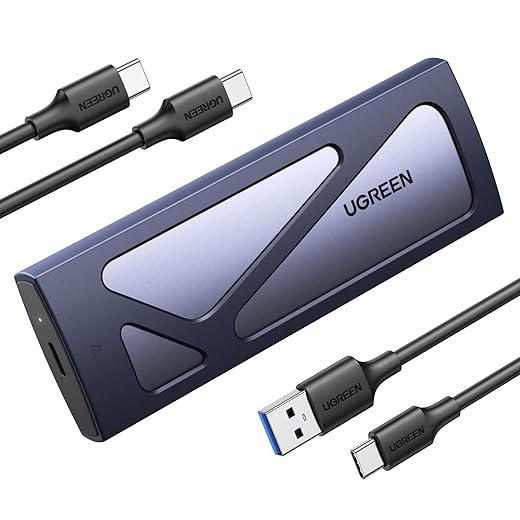
hero: A compact, tool-free NVMe-to-USB-C enclosure for on-the-go access to M.2 drives. quick summary: It converts internal M.2 NVMe modules into fast external drives using USB 3.2 Gen2 — ideal for backups, cloning, and portable workloads. technical breakdown: USB 3.2 Gen2 up to 10Gbps (UASP/TRIM support), RTL9210 controller with multi-protection, supports M and B+M keyed 2230/2242/2260/2280 up to 8TB, tool-free buckle design, cross-platform compatibility (Windows/Mac/Linux/Android/iOS where supported). real-world use cases: Useful for technicians cloning drives, creatives transporting project SSDs, and users expanding laptop storage temporarily. pros/cons: Pros — tool-free installation, wide key/size support, compact and travel-friendly; Cons — USB 10Gbps is slower than native PCIe speeds, thermal throttling possible under sustained heavy loads. final verdict: It is a highly practical adapter for portable NVMe use and quick backups; objectively it complements internal high-performance SSDs by providing portable access but cannot match internal PCIe throughput for sustained workstation tasks.
Sequential: single internal NVMe ~3–5 GB/s; multi‑NVMe/TB4 RAID ~7–12 GB/s.
4K random: aim for 50k–300k 4K IOPS depending on heavy timelines.
NVMe slot topology: prefer M.2 slots on direct CPU PCIe lanes (avoid chipset‑only x2 links).
External options: Thunderbolt/USB4 enclosures (RAID capable) for single‑user boosts; 10–25GbE or NVMe‑oF for shared studios.
Cooling & acoustics: expect increased fan duty under sustained exports—check manufacturer dBA and sustained throttle tests.
TCO: warranty length, on‑site service, SSD TBW/endurance, spare parts availability.
Who should buy a compact vs. full chassis
Compact minis suit freelancers, on‑location editors, and colorists who prioritize footprint and portability. Larger chassis remains the safer choice for multi‑GPU rigs, internal RAID and enterprise shared‑storage workflows.
Next, the article closes with a concise conclusion synthesizing these recommendations.
Conclusion: Compact Builds, Serious Throughput
Mini workstations with well‑designed ultra‑fast storage prove that compact hardware can sustain massive video‑editing throughput when micro‑architecture, storage topology, thermal management and expandability are balanced. The hero picks, quick summary shortlist, technical breakdown, real‑world use cases, pros/cons and final verdict together show buyers how to compare systems objectively across sustained I/O, thermal behavior and upgrade paths. They should prioritize sustained transfer benchmarks, realistic codec workloads and cooling efficiency over peak specs.
Use the provided technical checklist and benchmark targets as pass/fail gates during evaluation. When they match workflow requirements and thermal limits, a tiny workstation becomes a practical, high‑performance editing platform—compact, efficient and predictably fast. Always compare products objectively using measured sustained I/O, thermals and expansion headroom for long‑term reliability.
This page contains affiliate links. We may earn a commission at no extra cost to you.