They need a compact workstation case they can trust. This guide tests thermals, acoustics, expandability, IO and serviceability, then delivers hero profiling, a three candidate shortlist, technical comparisons, real world workflows, objective trade offs and a buying checklist today confidently.
They: familiarity with CPU/GPU sizes and PSU standards
Best Value
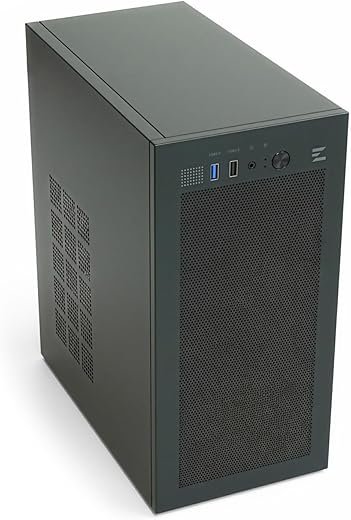
Zalman CUBIX Compact Steel mATX Mini Tower
Durable steel chassis in ultra-compact 17.1L
It is a compact, heavy-duty micro‑ATX mini tower built from 0.8T steel with a 17.1 L volume, supporting standard ATX PSUs, GPUs up to 260mm, and CPU coolers to 137mm with a preinstalled 80mm intake fan for basic airflow. Compared objectively with more modular SFF cases, it prioritizes structural rigidity and standard PSU compatibility over maximum radiator capacity or extreme fan mounting.
Hero Profile — Define the One Job the Case Must Do
Is size the hero, or reliability? One choice decides the rest.
Define the hero use case first: pick the single workload and environment the case must enable (e.g., 3D rendering workstation on a shared desk, portable video-editing rig for client sites). They then translate that into objective, measurable requirements.
📋 Free: Mini PC Buying CheatsheetThe 7-question framework we use to pick the right mini PC. Instant download.
Target noise ceiling (dBA) and weight for mobility
Example: for a 3080 Ti + 280mm AIO in a shallow desk, require ≥320mm GPU clearance and front 280mm radiator support. The hero profile becomes the baseline for apples-to-apples comparison and filters out marketing claims.
Editor's Choice
Cooler Master NR200 High-Airflow Mini-ITX Chassis
280mm radiator support, versatile cooling layout
It is a compact Mini‑ITX chassis engineered for high-performance cooling, supporting up to a 280mm radiator, multiple fan mounts (up to six 120mm), and GPUs up to 330mm when paired with an SFX PSU, plus optional tempered glass or vented panels. Compared to mATX alternatives, it trades motherboard expandability for exceptional thermal headroom and flexible GPU mounting (including vertical), making it ideal for high‑end ITX builds.
Skip endless browsing — these three archetypes cover 90% of pro needs. Which one wins?
Reduce the market to three finalists: a high-performance mini‑ITX SFF, a compact mATX workstation, and an SFX‑expansion chassis.
Record for each candidate:
Dimensions (WxHxD)
GPU and CPU cooler clearances (mm)
Radiator mounting locations & max sizes
Drive bays and M.2 slots
Front I/O bandwidth (USB-C, TB4, USB3.2)
Stock fan count and placement
Street price and PSU type
Cross‑check manufacturer specs with verified teardown reviews and user reports to confirm reliability, cooling behavior, and firmware/BIOS support.
Eliminate any model that fails the hero profile thresholds — for example, discard candidates with GPU clearance below the required mm, missing PCIe lane support, or user-reported thermal throttling despite claimed specs.
Portable Build
JONSBO Z20 Carry-Handle Micro-ATX Compact Case
Detachable handle and multiple PSU form-factors
It is a ~20L micro‑ATX chassis with a detachable carrying handle, 2mm steel panels, magnetic dust filters, adjustable PSU positioning (ATX / SFX / SFX‑L), top support for 240 AIO, and GPU clearance up to 363mm depending on configuration. Objectively, it delivers more motherboard and PSU flexibility than many ITX cases while keeping portability and robust construction as priorities.
Technical Breakdown — Thermals, Acoustics, and Power Delivery
Thermals, acoustics, and power delivery: the boring stuff that decides win/loss.
Analyze airflow topology first. Inspect whether the case uses front-to-back, bottom-intake, or top-exhaust flow, note GPU exhaust direction, and count dedicated intake vs exhaust mounts. Verify fan mounting and PWM control and record stock fan specs (size, rpm, static pressure).
Assess cooling capacity: list radiator positions and max thickness (with fans), CPU/GPU cooler clearances, and available surface area for passive dissipation (side/top vents, chassis mass).
Measure using consistent methodology:
Thermals: record CPU/GPU delta‑T against ambient under sustained Blender render and synthetic GPU load.
Acoustics: measure dBA at idle and load, microphone at 30 cm.
Stability: run long benchmarks to detect throttling.
Evaluate power delivery: confirm PSU form factor (ATX/SFX/SFX-L), cable-routing space, and clearance for 8/16‑pin GPU connectors and SFX adapter placements.
Compare candidates on identical test rigs where possible, then highlight thermal bottlenecks (poor intake, GPU heat recirculation) and acoustic trade‑offs (higher airflow vs higher noise).
Best Compact Choice
Cooler Master Q300L Modular Micro-ATX Compact Case
Adjustable I/O panel with perforated airflow
It is a modular cube‑style micro‑ATX case featuring six-position adjustable I/O, full perforated panels for improved airflow, magnetic dust filters, and support for 240mm liquid cooling and GPUs up to 360mm. Compared with competing compact chassis, it offers a strong balance of expandability, configurable layout, and airflow for office or home builds without sacrificing dust control.
Is it for rendering farms, audio booths, CAD benches, or developer desks? One case won’t fit all.
Map each shortlisted case to a real workflow. Provide concise example builds, thermal/acoustic targets, and deployment notes so buyers see where trade‑offs hit productivity or reliability.
Video editing: Example build — 12–16‑core CPU, RTX 4070/CTV‑class GPU, 2×3.5″ + 2×NVMe. Targets: CPU ΔT <45°C under export; GPU ΔT <40°C; noise <40 dBA. Deploy: permanent workstation; favor Candidate A (radiator-first). Trade‑off: smaller cases with limited drive bays reduce archive speed.
3D rendering: Example build — 16+ cores, dual‑slot GPU, thick rear/top radiators. Targets: sustained GPU clocks, GPU ΔT <50°C; noise tolerable to 45 dBA for throughput. Deploy: 24/7 render node; choose Candidate B (high GPU clearance). Trade‑off: less portable.
Audio production: Example build — quiet CPU, low‑power GPU, 4×NVMe. Targets: idle <30 dBA; transient spikes <35 dBA. Deploy: portable/live or studio; pick Candidate C (acoustics + port access). Trade‑off: modest thermal headroom.
Software development: Example build — efficient CPU, dense NVMe, hot‑swap-friendly. Targets: stable thermals under compile load; noise <40 dBA. Deploy: portable desk unit; prefer Candidate C for serviceability. Trade‑off: fewer radiator options may limit overclocking.
5
Objective Pros & Cons — Side-by-Side Trade-offs
No fluff: every compact case pays with compromises. Here’s the exact bill.
Present a side-by-side matrix that scores each chassis against hero thresholds and benchmark results. Use numeric deltas and dBA differences so trade-offs are explicit (not subjective).
Thermal headroom: +5–8°C GPU delta vs smaller footprint — acceptable for occasional long renders; >10°C is a red flag.
Acoustic performance: -2 to -4 dBA with larger intake fans buys quieter desks; >6 dBA penalty is unacceptable for noise‑sensitive work.
Expandability: Lose 1–2 drive bays for compactness; losing hot‑swap rail is a hard limit for archive-heavy workflows.
Ease of build / serviceability: Toolless panels score higher; blocked PSU rails or inaccessible M.2 slots are hard limits.
Cost & warranty/support: Higher price tolerates smaller compromises; <1‑year warranty is a deal breaker.
Recommend tolerances (GPU ΔT ≤+7°C, noise Δ ≤+4 dBA, ≤2 drive bays lost). Flag any chassis that exceeds hard limits (insufficient GPU length, no hot‑swap, inaccessible rails).
6
Final Verdict & Buying Checklist — Pick with Confidence
A concise, technical buying checklist — and the one recommended path per persona.
Anchor the verdict to the hero profile — they prioritize the single job above brand hype.
Present the prioritized checklist (in order):
Fit: verify GPU length, CPU cooler height, and drive cage clearance.
Thermals: confirm verified delta-Ts and radiator/fan compatibility.
Acoustics: check fan sizes, RPM profiles, and measured dBA.
Mobile pro: compact SFF with Thunderbolt, SFX‑L support.
Rendering tower: compact ATX with room for long GPUs and 360mm rad.
Compact enterprise node: dense SFF with hot‑swap or rack options.
Verify before purchase: check clearances on specs, confirm radiator/fan fit, read independent thermal tests, and confirm spare‑part/service options. Run post‑purchase tests: fit check, idle/load temps, and real‑world noise measurements.
Conclusion — From Criteria to Confident Choice
They now have a repeatable, technical process: define the hero profile, create a quick summary shortlist, run a technical breakdown, vet real-world use cases, weigh objective pros/cons, and apply the final verdict checklist to compare products with confidence. Ready now?
This page contains affiliate links. We may earn a commission at no extra cost to you.