Step-by-Step Guide to NVMe RAID: Maximize Workstation Throughput
Quick Answer
NVMe RAID on mini PCs with dual M.2 slots (e.g., Beelink SER7 Pro, Minisforum UN series) can boost sequential read speeds above 7,000MB/s using RAID 0 in Windows Storage Spaces. For practical use, separate drives for OS + projects (no RAID) is more reliable and nearly as fast. RAID 0 is not recommended for production data without a backup.
They need clear, practical guidance to design NVMe RAID arrays that squeeze maximum sustained throughput while balancing cost, reliability, thermals, and limited PCIe lanes. Shockingly, a single PCIe4 NVMe can exceed 7 GB/s; clever RAID multiplies bandwidth when planned effectively.
📋 Free: Mini PC Buying CheatsheetThe 7-question framework we use to pick the right mini PC. Instant download.
Motherboard or PCIe expansion card with sufficient lanes
RAID-capable hardware controller or OS-level RAID tools
Benchmarking tools (fio, CrystalDiskMark)
Adequate cooling and power
Basic sysadmin skills for configuration and troubleshooting
RAID Specialist
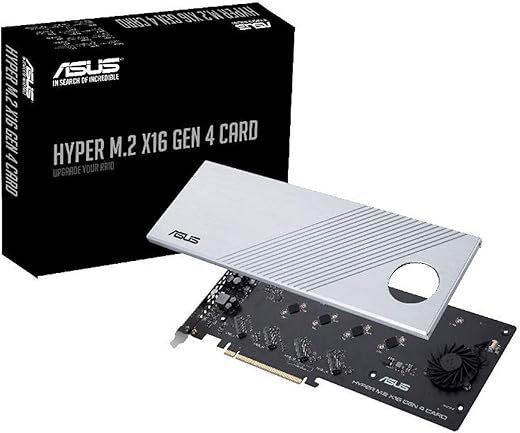
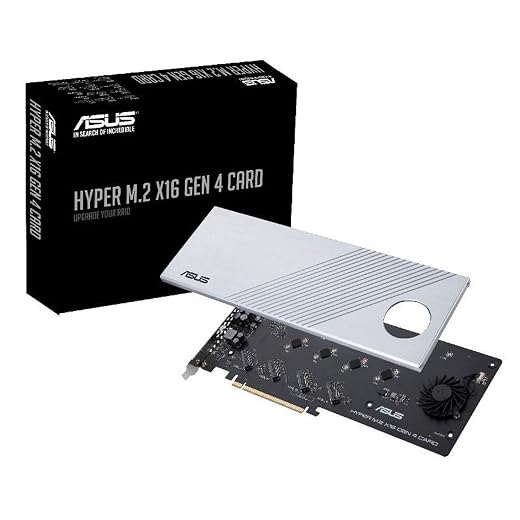
ASUS Hyper M.2 X16 PCIe 4.0 RAID Expansion
Supports four NVMe drives and VROC RAID
It is a PCIe 4.0 x16 expansion card that lets a workstation or server host four NVMe M.2 drives for high-bandwidth RAID configurations. hero: Designed for NVMe RAID and heavy I/O workloads, the card provides full PCIe 4.0 x16 bandwidth and active cooling to minimize throttling. quick summary: Ideal when a buyer needs to consolidate four high-power NVMe modules on a single slot for RAID or capacity expansion; supports 2242/2260/2280/22110 form factors and Intel VROC. technical breakdown: Uses a server-grade PCB and PCIe 4.0 x16 signaling (backwards compatible with x8/x16 slots); supports SSDs up to 14W; includes a heatsink plus integrated blower-style fan; enables up to ~256 Gbps aggregate bandwidth when paired with appropriate CPU/platform support and VROC/RAID firmware. real-world use cases: High-density NVMe RAID arrays for video editing scratch pools, database log or cache tiers, virtualization host storage, and high-throughput build servers. pros/cons: Pros — native support for four M.2 NVMe modules, robust cooling, optimized for VROC; Cons — requires motherboard/CPU/platform support for full PCIe 4.0 bandwidth and RAID firmware (e.g., Intel VROC or AMD platform-specific features), consumes a full x16 slot and requires high-power SSD compatibility. final verdict: The ASUS card is the clear choice for users who need an NVMe-dense RAID expansion with active cooling and server-grade PCB. Objectively, it complements high-performance SSDs like the WD_BLACK SN7100 and Kingston NV3 by providing the physical and electrical consolidation layer; it serves a different role than the StarTech SATA controller, which targets SATA drives and tiering rather than NVMe bandwidth aggregation.
Want blistering reads and writes or reliable capacity? Start with a clear throughput, latency, and redundancy target.
Define measurable goals. Set clear targets for sustained throughput (GB/s), IOPS, latency, usable capacity, and acceptable downtime before choosing a RAID topology. For example: aim for 12–14 GB/s sustained to edit multiple 8K streams, 500k–1M IOPS for a small DB cluster, or tail latency <1 ms for VMs.
Measure and document a single-drive baseline (sequential and random), and record the platform’s CPU and available PCIe lanes—he or she must know whether the CPU can support x4/x8 per NVMe without saturating the chipset.
Compare drive classes objectively: evaluate endurance (TBW / DWPD), sustained performance and thermal throttling, consistency under load, and warranty / enterprise features (power-loss protection, telemetry). Use these metrics to map workload requirements to RAID mode and drive selection.
Performance Leader
WD_BLACK SN7100 2TB Gen4 NVMe Performance Drive
High read/write speeds for gaming laptops
It is a Gen4 M.2 NVMe SSD engineered for laptop and handheld gaming with very high sequential read/write throughput and improved power efficiency. hero: Tuned for maximum game load and asset streaming performance, the SN7100 pushes Gen4 bandwidth to reduce load times and improve responsiveness on portable platforms. quick summary: Delivers up to 7,250 MB/s read and 6,900 MB/s write (1–2TB models), Next-Gen TLC 3D NAND, and firmware optimizations for power-aware devices. technical breakdown: PCIe Gen4 x4 interface, high sequential I/O for large file transfers and game streaming, NAND and controller tuned for performance-to-power ratio; supports capacities up to 4TB and is compatible with WD dashboard tools (Windows). real-world use cases: High-frame-rate gaming laptops, handheld consoles, content creators who need fast scratch space on portable systems, and users who want headroom for future game and AI workloads. pros/cons: Pros — industry-leading sequential speeds for its class, strong power efficiency for laptops, large capacity options; Cons — premium price vs mainstream NVMe drives, features like dashboard management are Windows-only. final verdict: For buyers prioritizing raw sequential throughput in portable systems, the WD_BLACK SN7100 is the top-performing consumer option here. Objectively, it outpaces the Kingston NV3 in sequential benchmarks but requires compatible Gen4 platforms to realize full gains; it pairs well with NVMe expansion hardware like the ASUS Hyper M.2 card when used in supported desktop/workstation setups.
Quick Summary — RAID Modes and Practical Trade-offs
RAID 0 for raw speed, RAID 1 for safety — but is that the whole story? Here are the real trade-offs.
Summarize RAID modes relevant to NVMe; he should pick RAID 0 for maximal sequential throughput, RAID 1/10 for redundancy with near-native performance, and RAID 5/6 for capacity efficiency at the cost of slower rebuilds and higher write penalty. Example: four identical NVMe in RAID 0 ≈ 4× sequential bandwidth but zero fault tolerance.
RAID 0: Best throughput; no redundancy; use for scratch or temp media.
RAID 1 / 10: Strong redundancy; good IOPS; use for boot/critical VMs.
RAID 5 / 6: Efficient capacity; higher rebuild overhead; use for large, read-heavy datasets.
Software RAID (mdadm, ZFS, Storage Spaces): Lower cost, flexible snapshots/replication; choose when CPU and PCIe lanes are abundant.
Hardware / NVMe RAID cards: Deterministic offload, sustained throughput under heavy writes; choose when lane or CPU limits demand dedicated controllers.
3
Technical Breakdown — How NVMe, PCIe Lanes, and RAID Interact
How many PCIe lanes are enough? Why controller offload and queue depth change everything.
Explain NVMe basics: it runs over PCIe, exposes many submission/completion queues (up to 64K queues × 64K commands) and uses namespaces to present storage. Expect low latency and massive parallelism; tune queue depth for sustained IOPS.
Specify PCIe lane allocation: M.2/U.2 devices commonly use x4 lanes. Bifurcation splits CPU/root-complex lanes — check root-complex limits (some CPUs/boards cap bifurcation or total downstream bandwidth).
Compare controller types:
CPU/software RAID (mdadm, ZFS): flexible, uses CPU cycles and host lanes.
HBAs / NVMe RAID cards: offload metadata/CRC and parity; conserve CPU but add card-level throughput limits.
Dedicated RAID accelerators: deliver deterministic sustained writes under load.
Watch thermal throttling and sustained vs burst: drives hit peak bandwidth briefly; without heatsinks sustained rates fall.
Compare objectively: software RAID may use ~15–40% CPU under heavy mixed IO; a RAID card with accelerator can reduce that to ~2–8% but may cap aggregate throughput. Gen4 x4 ≈ 7.88 GB/s per device; Gen5 x4 ≈ 15.75 GB/s — plan slots, lanes, and controllers accordingly.
Best Value
Kingston NV3 1TB PCIe 4.0 NVMe Value Drive
Value-focused Gen4 performance and low power
It is a cost-efficient PCIe Gen4 x4 M.2 NVMe SSD that balances strong sequential performance with low power and compact single-sided design. hero: Targets buyers who need Gen4 performance without the premium price, delivering up to ~6000 MB/s read and ~5000 MB/s write in a space-saving M.2 2280 form factor. quick summary: Offers Gen4 NVMe throughput, reduced thermal footprint, and capacities up to 4TB, making it suitable for mainstream workstations and gaming rigs that need affordable high-bandwidth storage. technical breakdown: PCIe 4×4 NVMe controller, optimized for power efficiency and thermal control; single-sided M.2 2280 PCB to ensure compatibility with tighter laptop/desktop M.2 slots; available in multiple capacities. real-world use cases: Main system drives for developers, gamers, and creators who want Gen4 speed on a budget, secondary high-speed storage for caches, and compact builds where single-sided modules are required. pros/cons: Pros — strong price-to-performance for Gen4, low power and thermal profile, wide capacity options; Cons — slightly lower peak sequential throughput than flagship Gen4 drives (e.g., WD_BLACK SN7100) and fewer high-end firmware optimizations. final verdict: The Kingston NV3 is the pragmatic choice for buyers who need Gen4 NVMe performance at a lower cost. Objectively, it trades some peak throughput versus the WD_BLACK for better value, and it complements NVMe aggregation solutions like the ASUS Hyper M.2 card when many drives are needed economically.
Real-World Use Cases — When NVMe RAID Truly Pays Off
Is NVMe RAID a gamer flex or essential for editors, DBAs, and VFX houses? The answer may surprise.
Map RAID modes to workloads: they pick the RAID topology that aligns latency, throughput, and redundancy needs.
Choose RAID 0/10 for video-render scratch disks and VFX: maximize sequential throughput, use high-endurance consumer NVMe (Samsung/WD) with heatsinks; accept lower redundancy but gain speed for scratch space.
Choose RAID 10/5 for mixed read/write databases: prioritize consistent tail latency and rebuild behavior; use low-latency enterprise drives (Micron/Kioxia) or HBAs with battery-backed cache.
Choose high-parity RAID (RAID6/erasure) for archival capacity: prioritize cost-per-TB and space efficiency; use high-capacity consumer/nearline drives and robust parity controllers.
Compare objectively: Samsung/WD consumer = higher peak throughput, better $/TB, lower DWPD. Micron/Kioxia enterprise = higher DWPD, tighter tail latency, higher cost. Justify Optane-like media only for metadata, journaling, or ultra-low-latency DB hotspots.
5
Pros/Cons — Risks, Costs, and Real Limits
Unleashed throughput versus rebuild headaches and heat — can they have it both ways?
List the key pros and cons.
They gain massive parallelism, reduced I/O wait, and lower job completion times; for example, a four-drive RAID0 stripe can multiply sequential throughput for video renders.
Advantages: Massive parallel throughput; lower tail latency for parallel workloads; predictable scratch-disk performance under heavy concurrency.
Disadvantages: Higher $/TB and power/thermal load; long rebuilds on multi‑TB NVMe increase chance of second‑device loss; rebuilds throttle performance and raise write amplification.
Operational pitfalls: NVMe failure modes include firmware hangs and controller loss; rebuilds on modern high‑capacity drives can take many hours and stress remaining devices.
Mitigations & buying guidance: Use backups/replication (snapshot + offsite copy), prefer enterprise drives for higher TBW and stable firmware, and factor in stricter RMA and DWPD when computing total cost of ownership.
Versatile Storage Controller
StarTech 4-Port PCIe SATA III RAID Controller Card
SATA III ports with HyperDuo SSD tiering
It is a 4-port PCIe 2.0 SATA III controller with Marvell RAID and HyperDuo SSD tiering to combine SSD performance with HDD capacity. hero: Designed for systems that require more SATA ports, hardware RAID (0/1/1+0), and automatic SSD/HDD tiering to accelerate frequently accessed data without fully migrating to NVMe. quick summary: Adds four 6Gbps SATA ports via PCIe x1/x2, supports Port Multiplier for up to seven drives, and provides HyperDuo auto-tiering and native RAID modes for cost-optimized throughput gains. technical breakdown: PCIe 2.0 interface, Marvell controller supporting AHCI, SATA III, NCQ, Port Multiplier, and onboard RAID (JBOD, 0, 1, 1+0); includes full and low-profile brackets and configuration utility; TAA compliant and backed by a 2-year warranty. real-world use cases: Expanding SATA capacity in servers and desktops, combining a small SSD cache with large HDD capacity for archival plus accelerated access, and environments where NVMe is not required or not supported. pros/cons: Pros — flexible SATA expansion, cost-effective SSD/HDD tiering (HyperDuo), and hardware RAID support; Cons — limited to SATA speeds (6Gbps), lower raw throughput vs NVMe solutions, and HyperDuo features have some OS/BIOS dependencies. final verdict: The StarTech controller is the practical solution for SATA-heavy environments that need tiering and RAID without moving to NVMe. Objectively, it fills a different niche than the NVMe-focused ASUS card, WD, and Kingston drives: choose this when large SATA capacity and tiering are required rather than maximum NVMe throughput.
Final Verdict — Design and Deploy an Optimized NVMe RAID Workstation
One clear recipe to maximize throughput without gambling on data loss — actionable checklist and product comparison advice.
Choose the RAID level from earlier: use RAID0 for max sequential throughput, RAID10 for mixed I/O with redundancy, and only consider RAID5/6 with enterprise drives and a capable controller.
Pick drives to balance endurance and cost: favor enterprise NVMe (higher TBW, power-loss protection) where rebuild risk matters; use consumer/scratch drives for ephemeral workloads with strict backups.
Select hardware RAID or software stack objectively: prefer hardware RAID for sustained multi‑drive sequential throughput and offloaded parity; prefer software RAID (mdadm, ZFS, Storage Spaces) for snapshots, flexibility, and easier recovery.
Ensure adequate cooling and telemetry: add heatsinks, monitor SMART/temperature/wear, and provision spares.
Run real benchmarks (fio, CrystalDiskMark) and validate under realistic concurrency and rebuild scenarios.
Go/no-go checklist:
Throughput target met: fio shows sustained performance under expected concurrency.
Rebuild risk acceptable: TBW and rebuild time within tolerance.
Thermals & monitoring in place: temps and alerts validated.
Conclusion
They should design NVMe RAID around PCIe lanes, cooling and workload, choose RAID level, drives and controller objectively, benchmark performance, and enforce backup discipline; try a build, compare results, and share findings to help others optimize throughput and iterate rapidly.