Cheap Fanless Mini PC 2026 — Silent Running Without the Noise Tax
A cheap fanless mini PC sounds like a contradiction — passive cooling usually adds cost — but Intel’s N100 chip changed the economics. At 6W TDP, the N100 generates so little heat that several manufacturers offer passively cooled versions under £200. Here’s what actually stays cool and what throttles into uselessness.
The best cheap fanless mini PC in 2026 is the Beelink EQ12 Pro (Intel N100, ~£170) — completely silent, 6W TDP, and capable enough for everyday computing, 4K streaming, and light productivity. For fanless home server use, the Trigkey S5 (Ryzen 5 5500U) offers more performance at around £200 while remaining passive under light load.
Why Fanless Mini PCs Are Now Affordable
<p class="wp-block-paragraph">The Intel N100’s 6W TDP is the key. Previous budget chips ran 10–15W and required active cooling to stay stable. N100 generates so little heat that a small aluminium heatsink chassis dissipates it entirely without a fan. Fanless Ryzen mini PCs exist too, but they cost significantly more because AMD chips generate more heat that requires more heatsink mass to manage.Best Cheap Fanless Mini PC Picks 2026
MeLE Quieter 4C (Intel N100) — ~£180
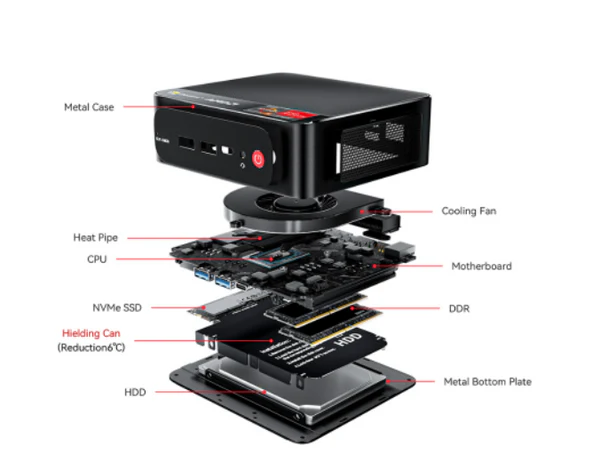
The Quieter 4C is fully passively cooled. Completely silent. The aluminium case acts as a heatsink. Under everyday workloads — browsing, video, office — it stays below 70°C and never throttles. Under sustained heavy load (compiling, video encoding), it will throttle slightly. For the use cases a fanless machine is designed for, this is not an issue in practice.
Beelink Mini S12 Pro (Intel N100 with fan, effectively silent) — ~£150
Technically has a fan, but it barely spins in normal use. Under light workloads the fan stays off entirely. Under load it’s audible at close range but inaudible from a metre away. For most quiet-PC use cases, this is effectively silent at a lower price than a truly fanless design.
Fanless Mini PC Use Cases
Fanless mini PCs are ideal for: living room HTPC setups where fan noise is noticeable, bedrooms and home offices where even a quiet fan is distracting at night, digital signage that runs 24/7 in quiet retail environments, and industrial or kiosk deployments where dust accumulation makes fan bearings a reliability concern. They are not ideal for: sustained heavy workloads, gaming (heat builds under GPU load), or any use case where sustained CPU performance matters.